
A companion to Episode 1 of Artworld Radio, the art podcast from Artworld Projects, in which Alexander Moore talks to the French-Polish photographer and artist Nicolas Grospierre. Prefer to listen? Hear the episode on Artworld Radio.
Nicolas Grospierre calls himself a “professional amateur”. It is a joke, but a serious one. He never went to art school; he studied political science and sociology, and came to photography through his father, a filmmaker and writer who handed over his cameras, paid for every roll of film, and then warned his teenage son that photography was far too hard a profession to choose. Grospierre chose it anyway. Over the following decades his practice has grown from photographs of buildings into mirrored installations, photographic objects and, most recently, heliograms: images made over months by the sun itself. What holds it all together, he says, is curiosity, “an open-ended understanding of photography”.
Volumes under the light
When you have no formal training and you live in a city, Grospierre points out, the obvious thing to do is walk and photograph what you see. In Paris, London and later Warsaw, what he saw was buildings. People were there too, of course, but he was drawn to the plasticity of architecture, and he quotes Le Corbusier’s definition of it as “the learned, magnificent and wise game of volumes assembled under the light”. As you walk, the volumes move around you, and the camera follows.
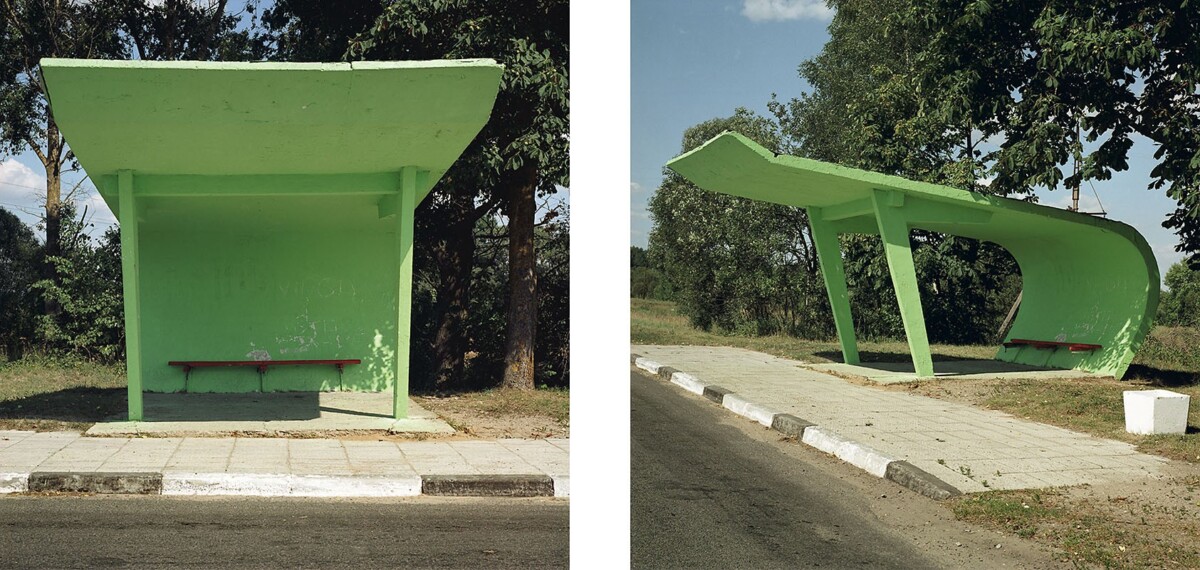
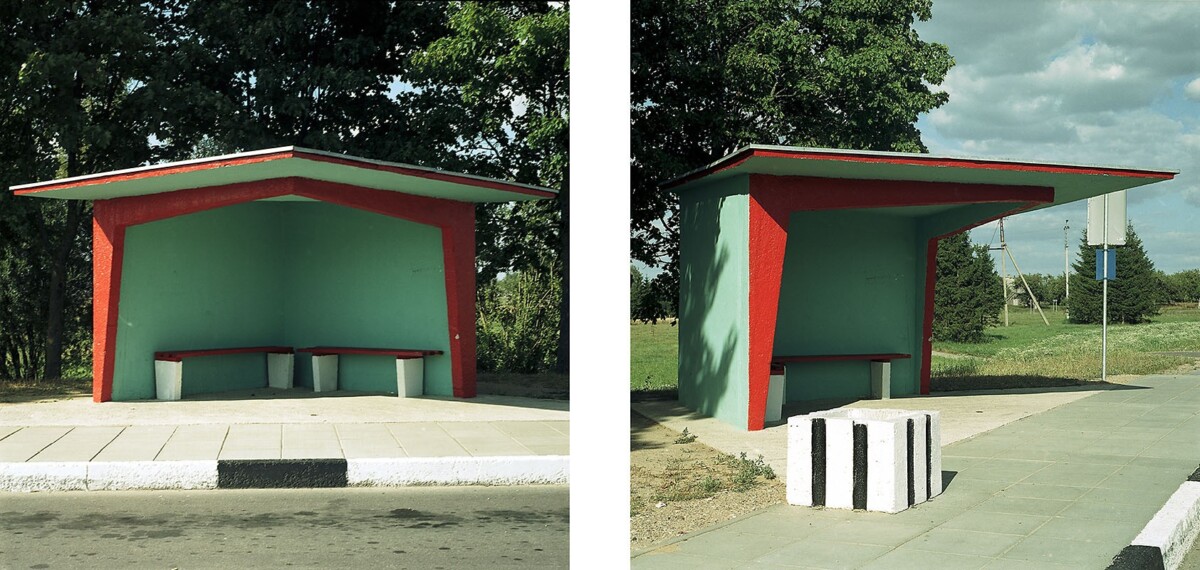
His subject is almost always late modernism: post-war public buildings and brutalism, architecture that left the private villa behind and went out to serve the public. For him these buildings embody an idea of progress, and of a society’s generosity towards itself. He has little interest in new buildings, and he only recently worked out why. They have no patina, no marks of having been lived in. A philosophy teacher once told him that a new tool is merely useful, while an old tool is beautiful because it carries the effort and sweat of the people who used it. Grospierre looks at old buildings the same way, so even his empty interiors are, in a sense, portraits of the people who passed through them.
He usually knows what he is going to photograph before he sets out. But the best moments are unplanned. Alexander remembers driving him to a residency at Dalkeith Palace, running late, when Grospierre suddenly asked him to pull over. It was not an emergency. It was a fire station that had to be photographed, then and there. His family, he admits, now scream from the back seat whenever he touches the brake for no apparent reason.
A limitless library
Grospierre made his first “photographic object” around 2001, but the real break came in 2006 with an installation based on the idea of a library. He had long loved Jorge Luis Borges’s story The Library of Babel, which imagines the universe as an endless library, and he wondered how you might show something limitless. The answer turned out to be surprisingly simple: one-way mirrors and light boxes, which multiply a photograph of shelves into a corridor of books that never ends.
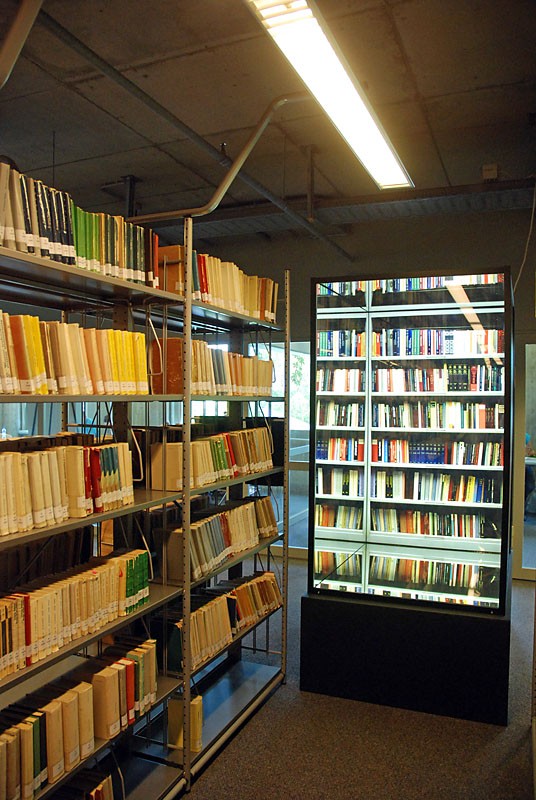
From then on a photograph no longer had to be a flat print. If an idea could be expressed better in three dimensions, he would build it. Not having trained as an artist, he feels, made this easier, because no one had ever told him how things ought to be done. He has only one rule: “It needs to work.” A new form has to earn its place by saying something the idea needs, not simply because it would look strange or striking.
Heliograms: the sun as subject and tool
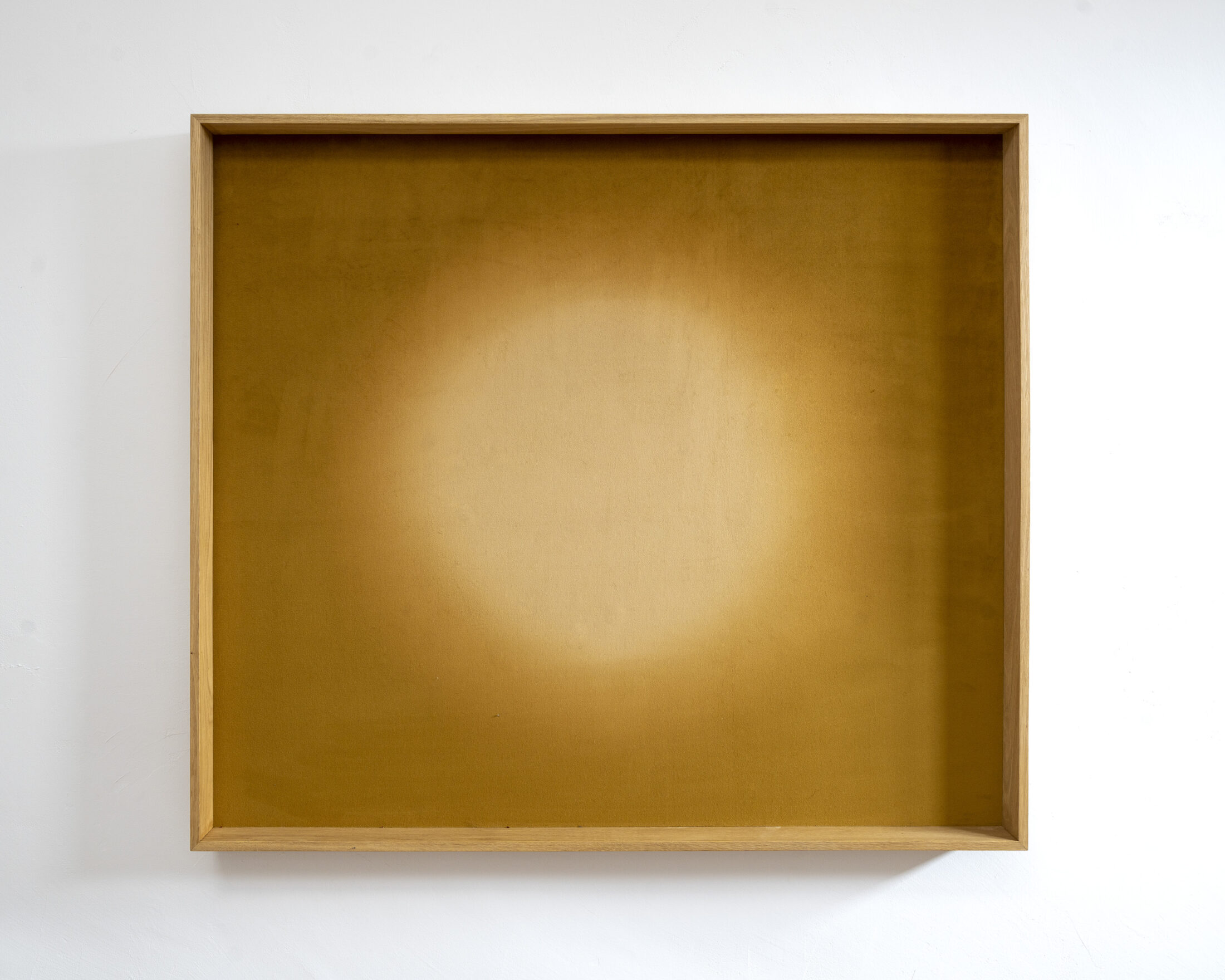
The heliograms began, like the buildings, on a walk. About ten or twelve years ago Grospierre passed a public noticeboard lined with coloured felt behind glass. The notices had just been taken down, and where the paper had hung the felt kept its original colour, while the rest had faded in the sun. The result looked to him like a monochrome Mondrian: overlapping squares and rectangles in one colour at different strengths.
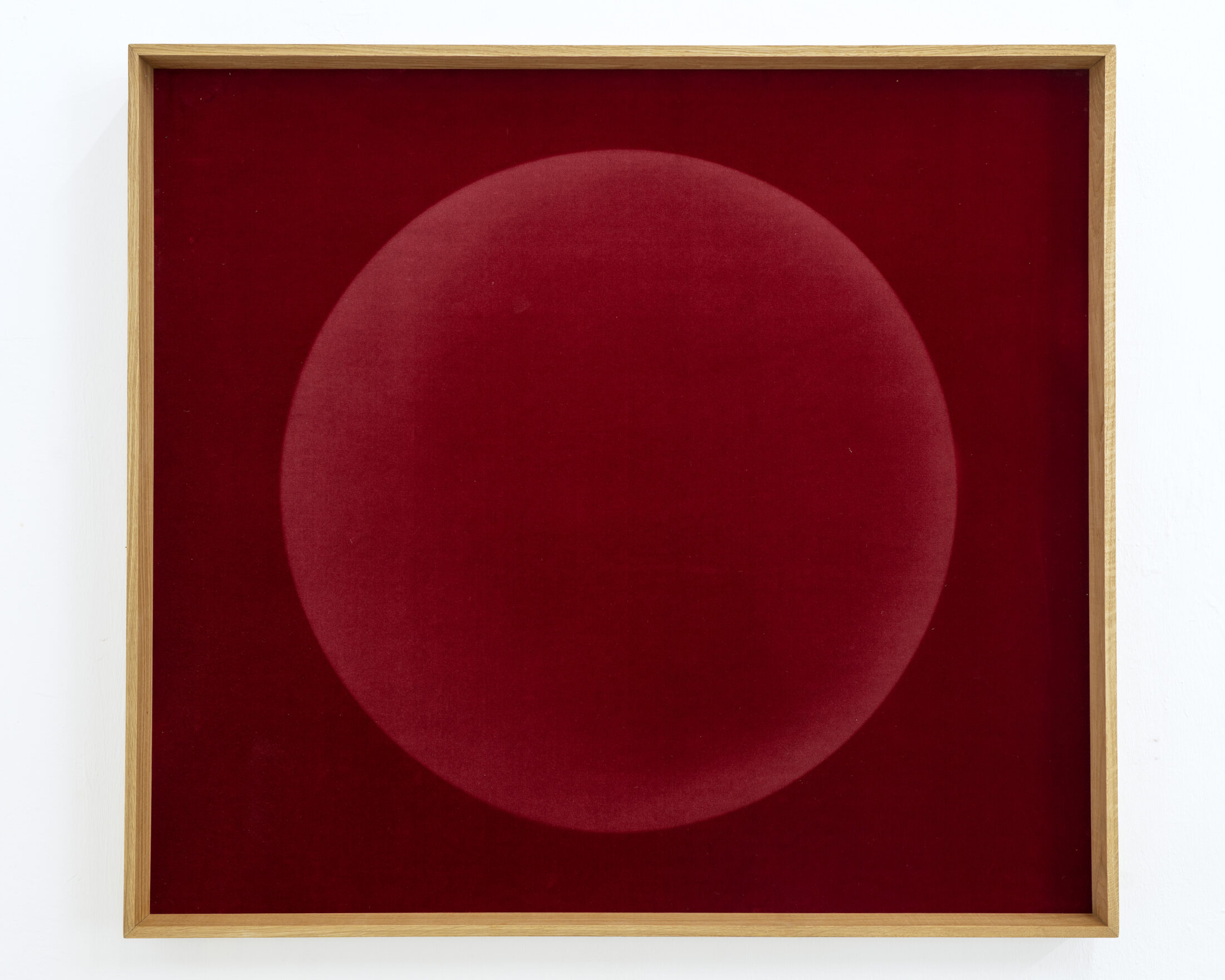
Today he lays fabric outdoors, places shapes on top to block the light, and leaves the sun to do the work. Depending on how the shapes are placed, the edges come out razor-sharp or melt into soft gradients. A single heliogram takes four or five months, from late April to mid-September, and some need a second summer. Over the years the shapes have drifted from hard-edged rectangles towards the circle, which he compares to a fire: build it on a square, keep feeding it, and it always ends up round. The sun, as he puts it, is both the instrument of the work and its subject.
Alexander brings up the camera obscura, and the way sunlight through leaves scatters little images of the sun on the ground, something Aristotle described and the Japanese call komorebi. Grospierre hadn’t thought of it that way, but he agrees: a heliogram is a kind of giant camera obscura, with the light passing not through a pinhole but through a template of his own design. The spiritual side matters to him more than any divine one. He quotes La Rochefoucauld’s maxim that neither the sun nor death can be looked at steadily. A heliogram has stared at the sun for months, so it lets us look at something life-giving and destructive, and far bigger than us, that we could never look at directly.
Perfection, accidents and AI
Grospierre uses artificial intelligence a great deal, and has even made a mirrored work imagining what it might look like. But when image generators arrived, he was devastated. Photography, for him, depends on its link with reality: a photograph is not reality, but it is a representation of something that exists. AI cuts that link. “What is the point of travelling halfway around the globe,” he asks, “when one well-defined prompt will do exactly the same?”
Could imperfection be the answer? His photographic objects have always had to be flawless, partly because we expect finished objects to be as perfect as a new phone, and partly because any flaw would give the illusion away. The heliograms are different. When a clip fell onto the fabric during his Dalkeith residency and left its own image, he told Alexander it was all part of the work. If an insect lands on a heliogram and dies there, leaving its trace, “all for the better”.
100% French, 100% Polish
Born in France and based in Warsaw, Grospierre would like to think that nationality doesn’t shape his work, while admitting that it is an illusion. “My way of thinking is French,” he says, “but my way of feeling is Polish.” He is proud that his heliograms have hung at the Royal Łazienki Museum in Warsaw, in rooms once given over to paintings, a place where, as he sees it, Polish and French culture meet.
Where next? He answers with Flaubert: for something to become interesting, you have to look at it long enough. He is still finding new things in the heliograms. This year he has been adding metallic powder and water to make rust, so a blue heliogram can carry a second colour. He also wants to make them in places that give the work its own context, not only at his country house in the north of Poland. And because he is, above all, curious, he says the heliograms will be one avenue among others.
Nicolas Grospierre’s work was shown in Land & Sea at Bowhouse, Fife, which Artworld curated and produced; the exhibition closed on 6 September 2026. See more of his work at nicolasgrospierre.com.
Hear the full conversation in Episode 1 of Artworld Radio: Spotify, Apple Podcasts or YouTube, or browse all Artworld Radio episodes.
Images © Nicolas Grospierre, reproduced with permission.