
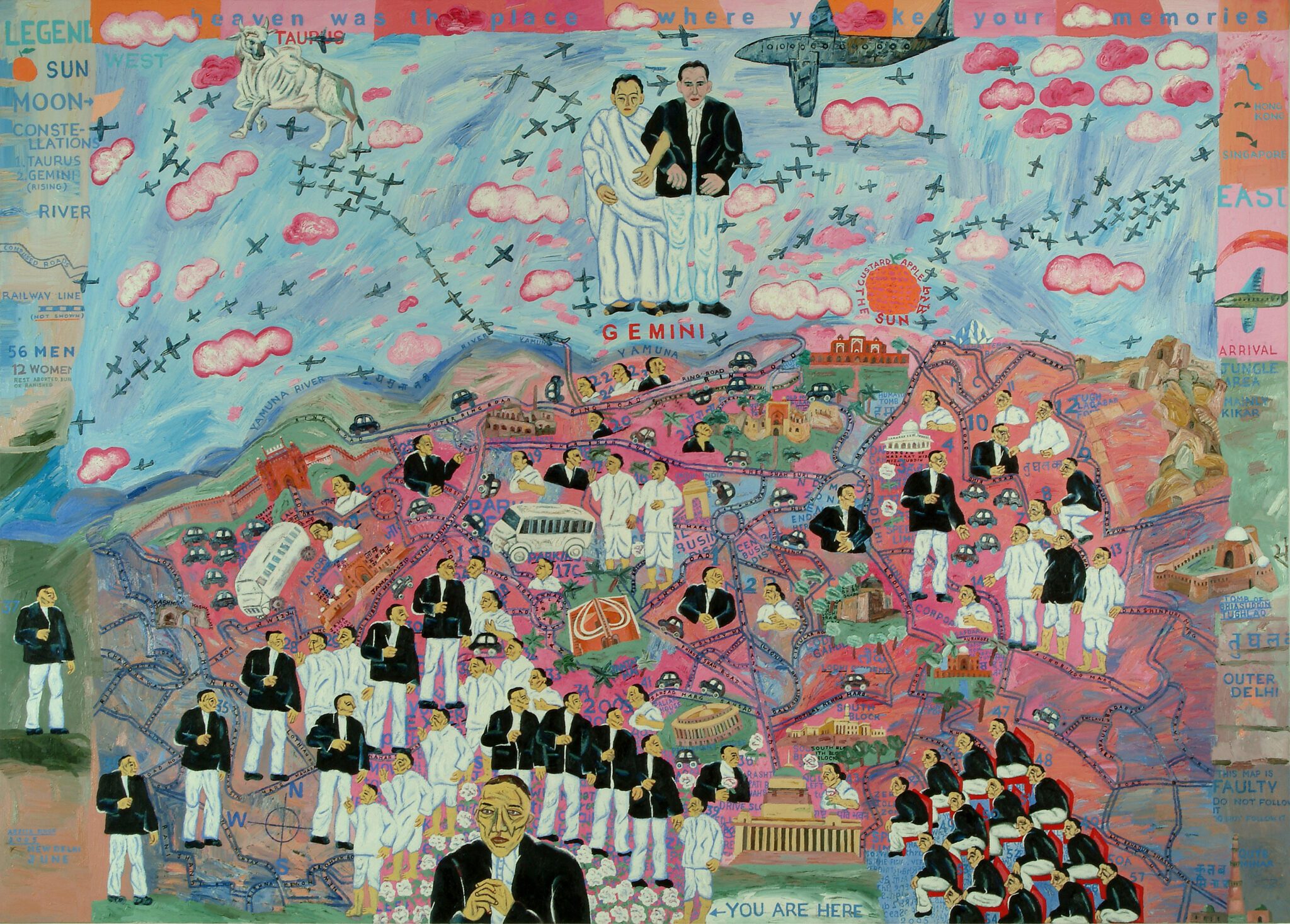
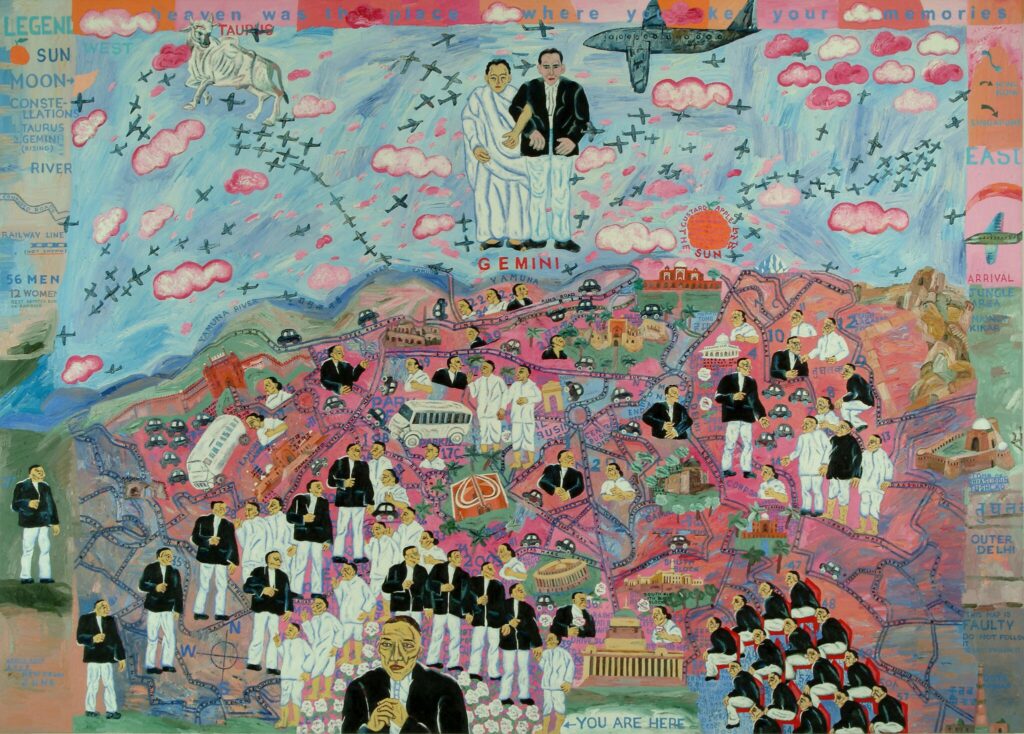
Among the painted street names of New Delhi in Arpita Singh’s My Lollipop City: Gemini Rising (2005), two notices contradict each other. One reads “YOU ARE HERE”. The other reads “THIS MAP IS FAULTY DO NOT FOLLOW IT”. Above the city a middle-aged couple, arm in arm – Gemini, rising on the horizon – floats among pink clouds and aeroplanes. Below, a tangle of roads fills with buses, cars and men in black jackets, and the Red Fort, Humayun’s Tomb and Jantar Mantar surface from the crowd.
The festive colour carries a warning. This is a map that tells you not to follow it, painted by an artist whose country was redrawn when she was ten. The art historian Devika Singh, writing for the Serpentine’s exhibition guide last year, named the inheritance directly: “Arpita Singh’s generation grew up with the memory of mass violence and displacement, of suspicion and betrayal.”
This autumn that generation lost two painters within 15 days. Jogen Chowdhury died in Kolkata on 25 October, aged 87. Arpita Singh died in New Delhi on 9 November, aged 89. Read side by side, their work maps the same broken ground in two very different hands.
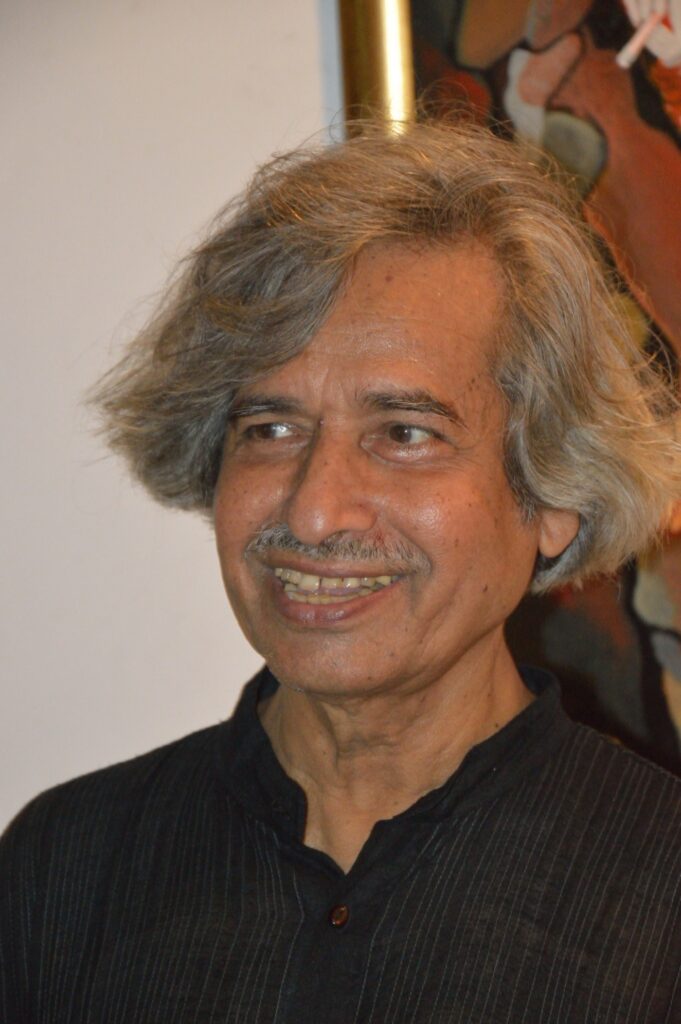
Born in Faridpur in 1939, in an undivided Bengal that now lies in Bangladesh, Jogen Chowdhury (1939–2026) moved with his family to Calcutta after Partition. As a boy he watched his mother paint alpana, the Bengali folk designs made on floors and walls. He graduated from the city’s Government College of Art and Craft in 1960 and went to Paris in 1965 on a government scholarship to the École nationale supérieure des Beaux-Arts.
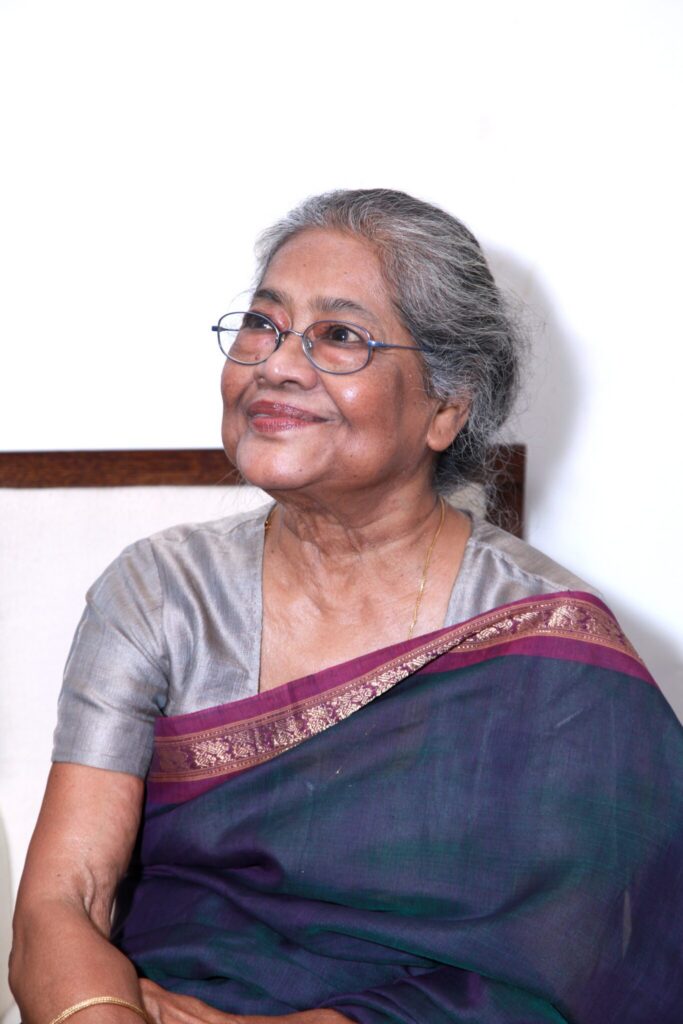
Born in Baranagar, on the northern edge of Calcutta, in 1937, Arpita Singh (1937–2026) moved with her family to Delhi in 1946, the year before independence and Partition. She graduated from Delhi Polytechnic in 1959 and became part of a circle of women painters, among them Nilima Sheikh and Nalini Malani.
Both passed through the same unlikely school. Each worked for the Weavers’ Service Centre, the government body that worked with India’s handloom weavers. For Singh it meant visits to museums and an education in pattachitra scroll painting and kantha embroidery, sources she would later fold into her own pictures. Chowdhury left in 1972 for a post that would shape his work more directly.
“Arpita Singh’s generation grew up with the memory of mass violence and displacement, of suspicion and betrayal.”
Devika Singh, art historian
Inside the President’s House
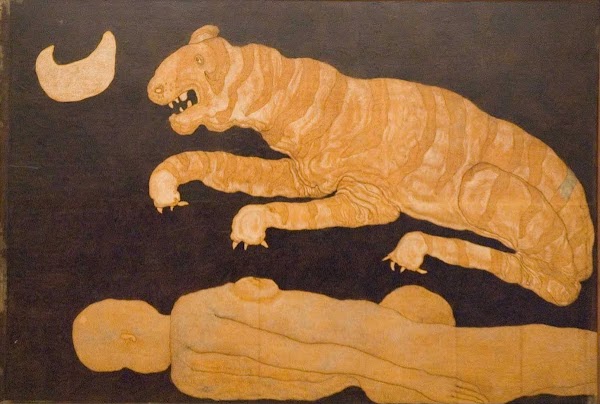
From 1972 to 1987 Chowdhury was the curator of the art gallery at Rashtrapati Bhavan, the President’s residence in New Delhi. He was there on 25 June 1975, when the prime minister, Indira Gandhi, declared a state of Emergency, a fortnight after a court had found her guilty of electoral malpractice. For 21 months civil liberties were suspended, newspapers were censored and most of her political opponents were jailed. It ended only when she called elections in March 1977, and lost them.
Tiger in the Moonlit Night, which the National Gallery of Modern Art in New Delhi dates to 1978–79, came out of those years. A pale tiger leaps across a dark ground under a crescent moon, mouth open and claws out, above a woman lying face down along the bottom of the sheet. “It depicted the fake emergency”, Chowdhury said, “and was an interplay between the real and the unreal.” The museum reads it another way, as “charged with the powerful undercurrents in a man-woman relationship”.
Late in life he sat in India’s upper house, the Rajya Sabha, from 2014 to 2020. His former student, the artist Mithu Sen, put it best: “He exposed moral decay and corruption with rare tenderness and a mischievous sense of humor.”
The Goddess with a Pistol
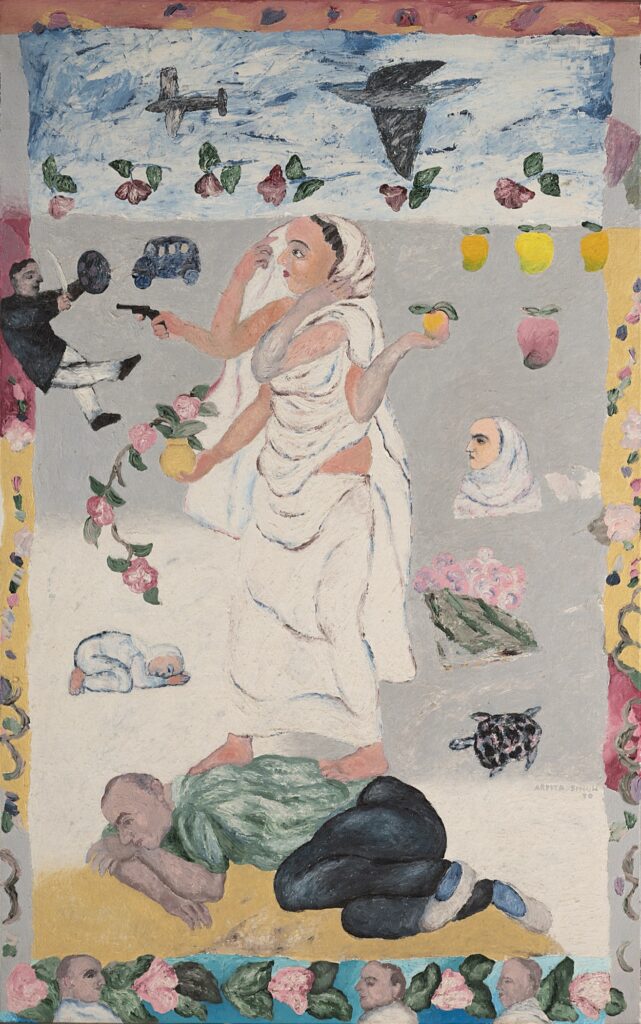
Singh’s protest took a different form. Devi Pistol Wali (1990) means, roughly, the goddess with the pistol. Devi is the Hindu name for the goddess in her many forms, and Singh paints her in a plain white sari, standing on the body of a crouching man. She has five arms, an odd number for a goddess, whose arms in devotional images come in pairs. Two hold the end of her sari over her head. The other three carry a pistol, a vase of flowers and a mango. The writer Arushi Vats sees her “not as a deity, but as a fusion of oracular power and rebel spirits”.
In recent years home itself became a subject. In Homeward (2020) a small black boat floats in a sea of repeated words – “boat”, “paper boat”, “want to go back home”. The new paintings in her final exhibition carry titles such as Dreaming home and Until you can build a home inside. For an artist who left Bengal as a child, it is hard not to read them as a last return to the map.
A Late Arrival
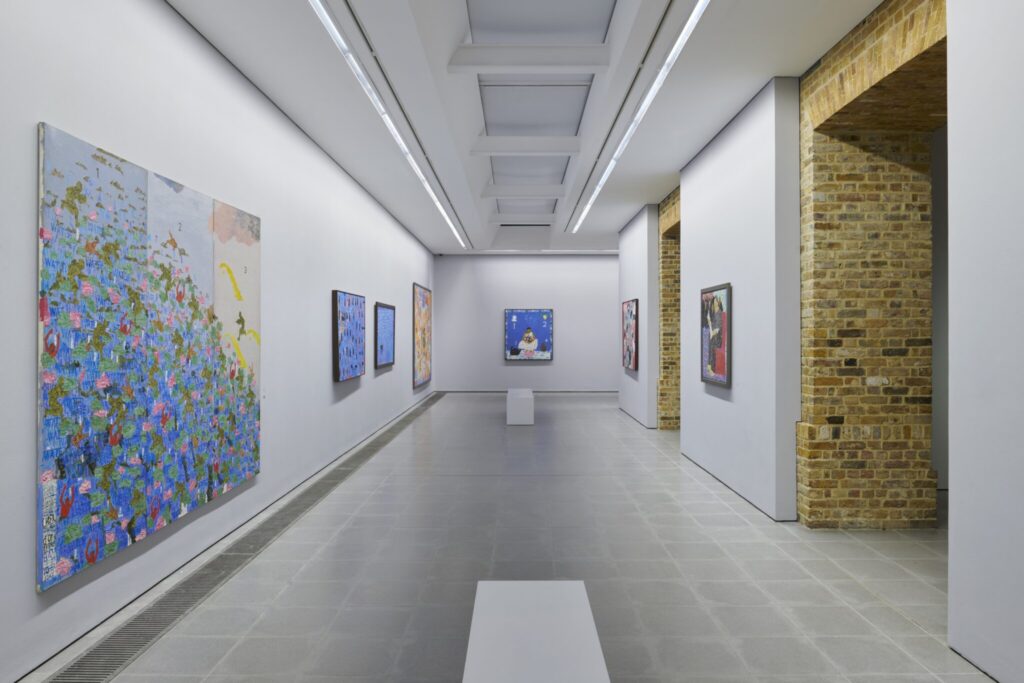
Neither painter was unknown abroad. Chowdhury showed in Seoul, Amsterdam, New York and London, and Singh at the Royal Academy in 1982 and the Centre Pompidou in 1986. It was only in March 2025, though, that the Serpentine in London opened “Remembering”, the first institutional solo exhibition of her work outside India. She was 87. The Serpentine’s directors, Bettina Korek and Hans Ulrich Obrist, said they had first encountered her work while researching the exhibition “Indian Highway” in 2008, 16 years earlier.
As a curator, I think the late survey is a kind act and a revealing one. It brings a whole career into view at once, and it often arrives when the artist can no longer add to it. For Chowdhury, I have found no comparable museum retrospective outside India. Whether one follows will say more about museums than about him.
The Same Ground
There is no record here that the two were close, and their pictures look nothing alike. The case for reading them together is that they made the same move from opposite sides of a divided Bengal. Both carried the domestic and folk forms of Bengal into modern painting – Chowdhury’s mother’s alpana, Singh’s pattachitra and kantha – at the moment the new state was asking what an Indian modernism should be. Both then turned those forms on the state itself: Chowdhury from inside the President’s house, Singh from the crowded streets and maps of Delhi. Chowdhury’s swollen, crosshatched bodies and Singh’s teeming cities are two answers to one question, how to paint power when you have grown up inside its consequences. Together they describe a generation, and a Bengali modernism that museums abroad are only now beginning to see whole.
“I don’t remember myself, the frame breaks and I, the woman, stand there as anybody, as everybody.”
Arpita Singh
Singh once described how her pictures escape their starting points: “references become signals to lead anybody or everybody to the desired place.” Her faulty map works that way. It tells you where you are, then tells you not to believe it. Both painters spent their lives drawing that uncertainty, in a country whose borders had been drawn for them.
Images: Arpita Singh, My Lollipop City: Gemini Rising, 2005, Vadehra Art Gallery, © Arpita Singh. Jogen Chowdhury, photo Biswarup Ganguly via Wikimedia Commons (CC BY 3.0). Arpita Singh © Vadehra Gallery. Jogen Chowdhury, Tiger in the Moonlit Night, 1978–79, National Gallery of Modern Art, New Delhi, © the artist’s estate, reproduced for the purposes of criticism and review. Arpita Singh, Devi Pistol Wali, 1990, courtesy Museum of Art & Photography, Bengaluru, © Arpita Singh. Arpita Singh, Remembering, Serpentine North, photo Jo Underhill, courtesy Arpita Singh and Serpentine.
Get new Journal articles by email: join the Artworld mailing list.