
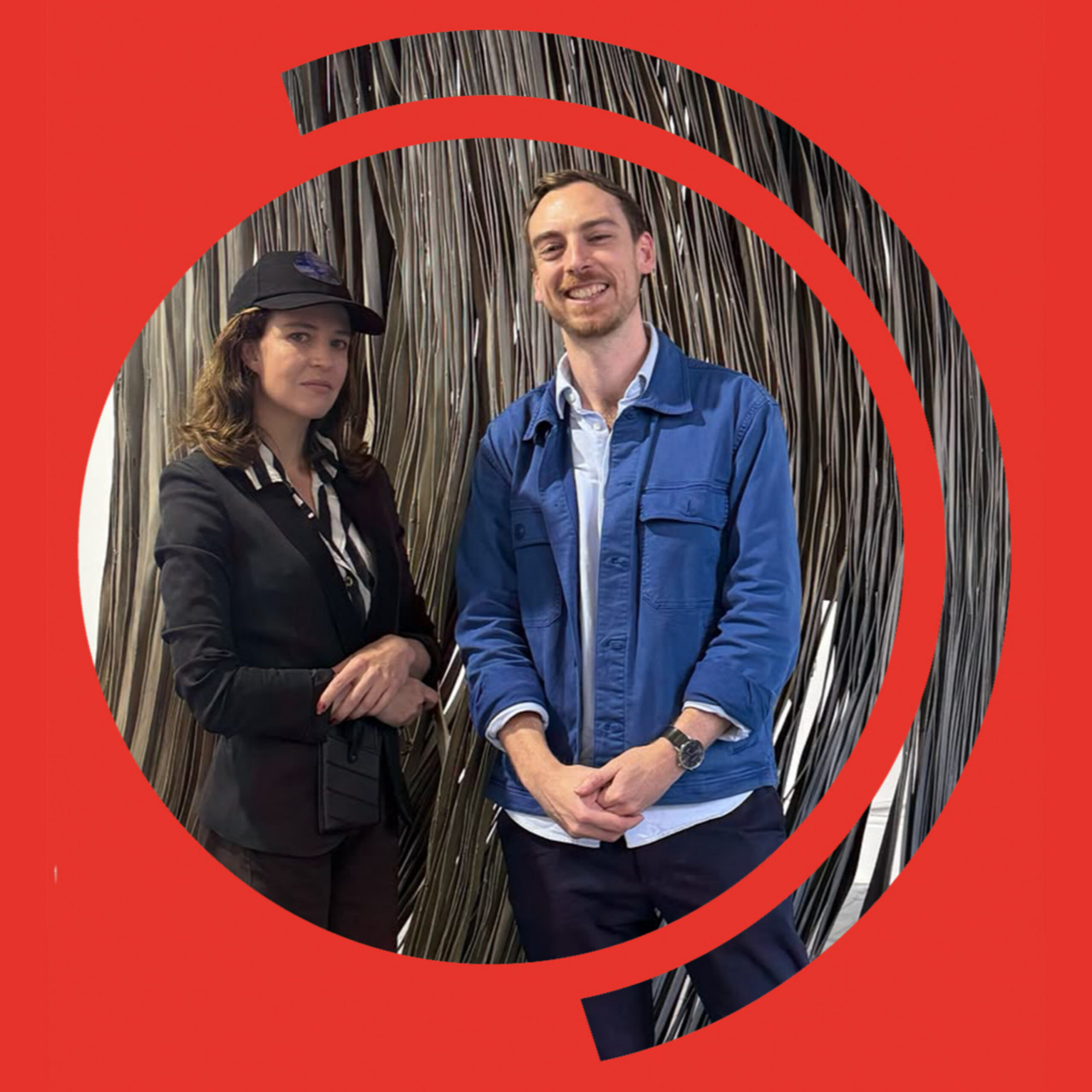
A companion to Episode 2 of Artworld Radio, the art podcast from Artworld Projects, recorded with the artist Nika Neelova among the works of her exhibition Gyre at The Bomb Factory, Holborn, London. Prefer to listen? Hear the episode on Artworld Radio.
Alexander Moore texted Nika Neelova two hours before he turned up on a wet London afternoon, days before Gyre opened. “Normally in London nothing happens spontaneously,” she said, welcoming him in, so it must have been meant to be. The Bomb Factory, which runs affordable artists’ studios in buildings awaiting redevelopment, had given her space in Holborn. Inside were whale bones made of wood, staircases tied into loops, and glass lampshades that seemed to stare back. The first thing Alexander wanted to do was touch them. That, it turns out, is exactly what she hopes for: “They’re made by touch, and I feel like it needs to continue.”
A whale made of veneer
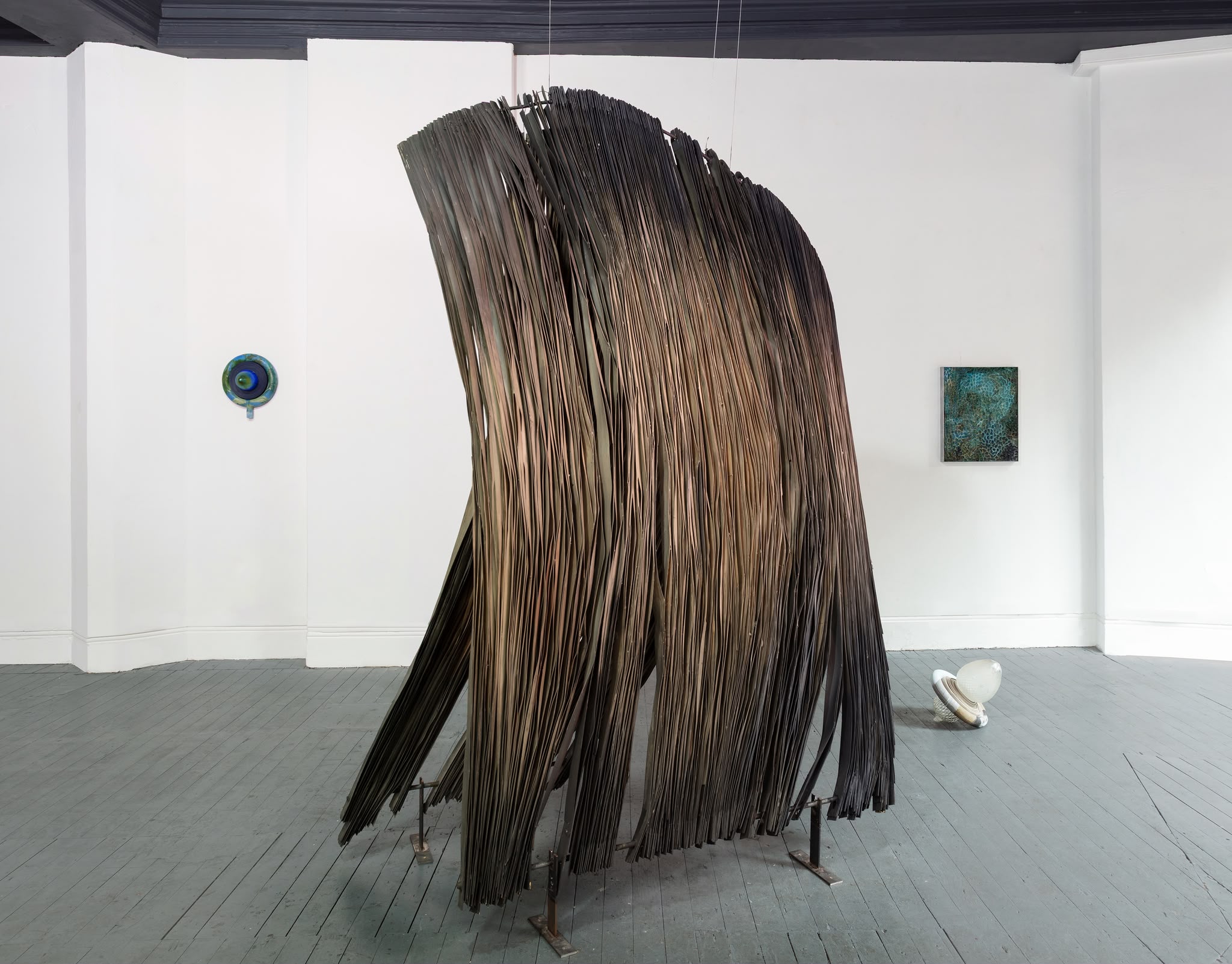
The largest work in the room is made from about two kilometres of salt-steamed wood veneer, hung while still hot so that gravity shapes it. It follows, at true scale, the skeleton of a baleen whale held in the comparative anatomy collection in Paris. Alexander’s first thought was the filter of a tumble dryer, and Neelova was delighted. That is more or less what baleen is: a giant filter, made of keratin like our hair and nails, that lets the whale sieve plankton from tons of seawater.
The piece was first shown in Salzburg, where visitors walked through it. For Neelova, whales carry the whole span of deep time: their movements map the rise and fall of the oceans, and they pass knowledge between generations. Industrial whaling drove them close to extinction, yet it also prompted one of the great conservation movements of the 1970s. That cycle of loss and return runs through everything she makes.
Handrails and the hands that held them
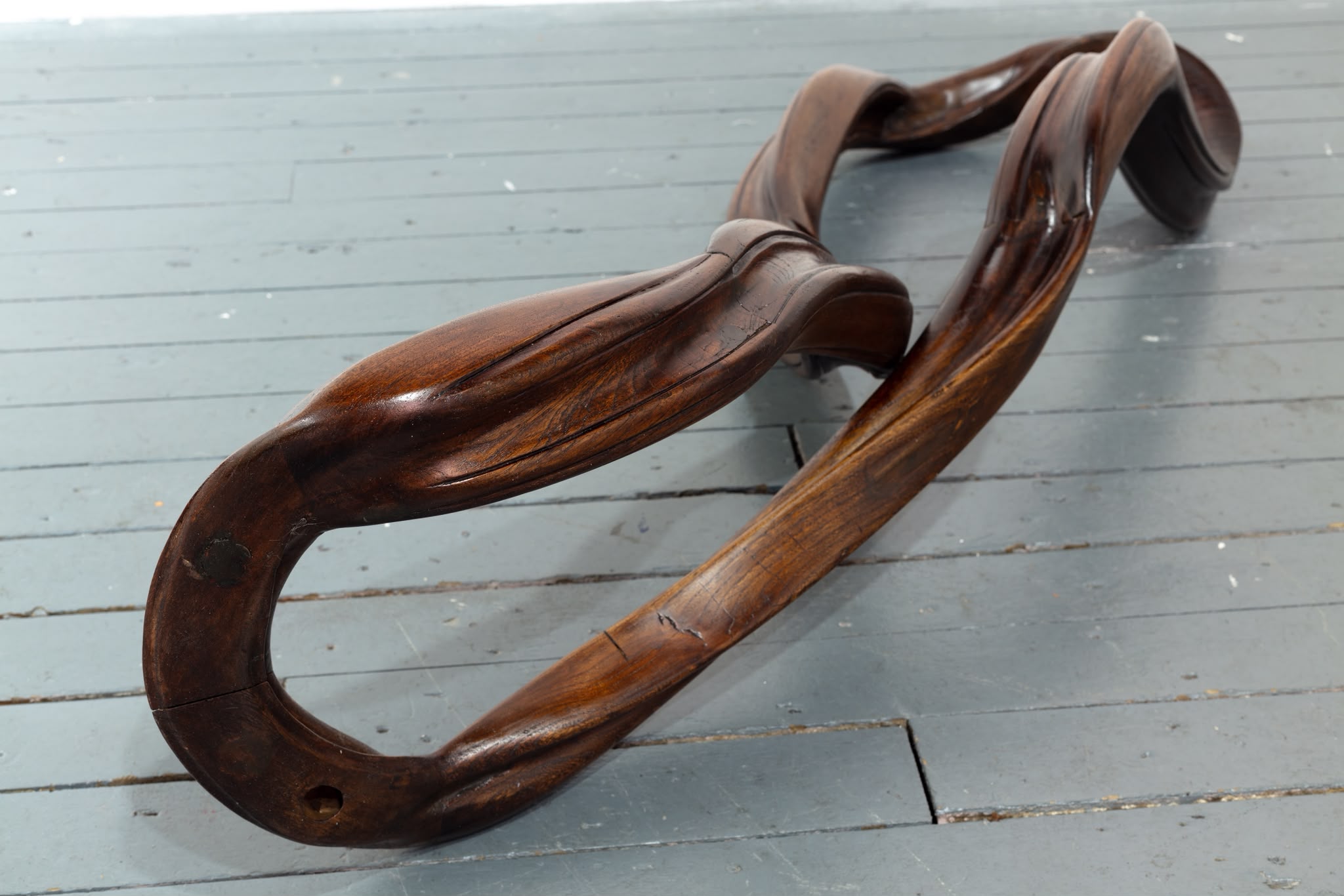
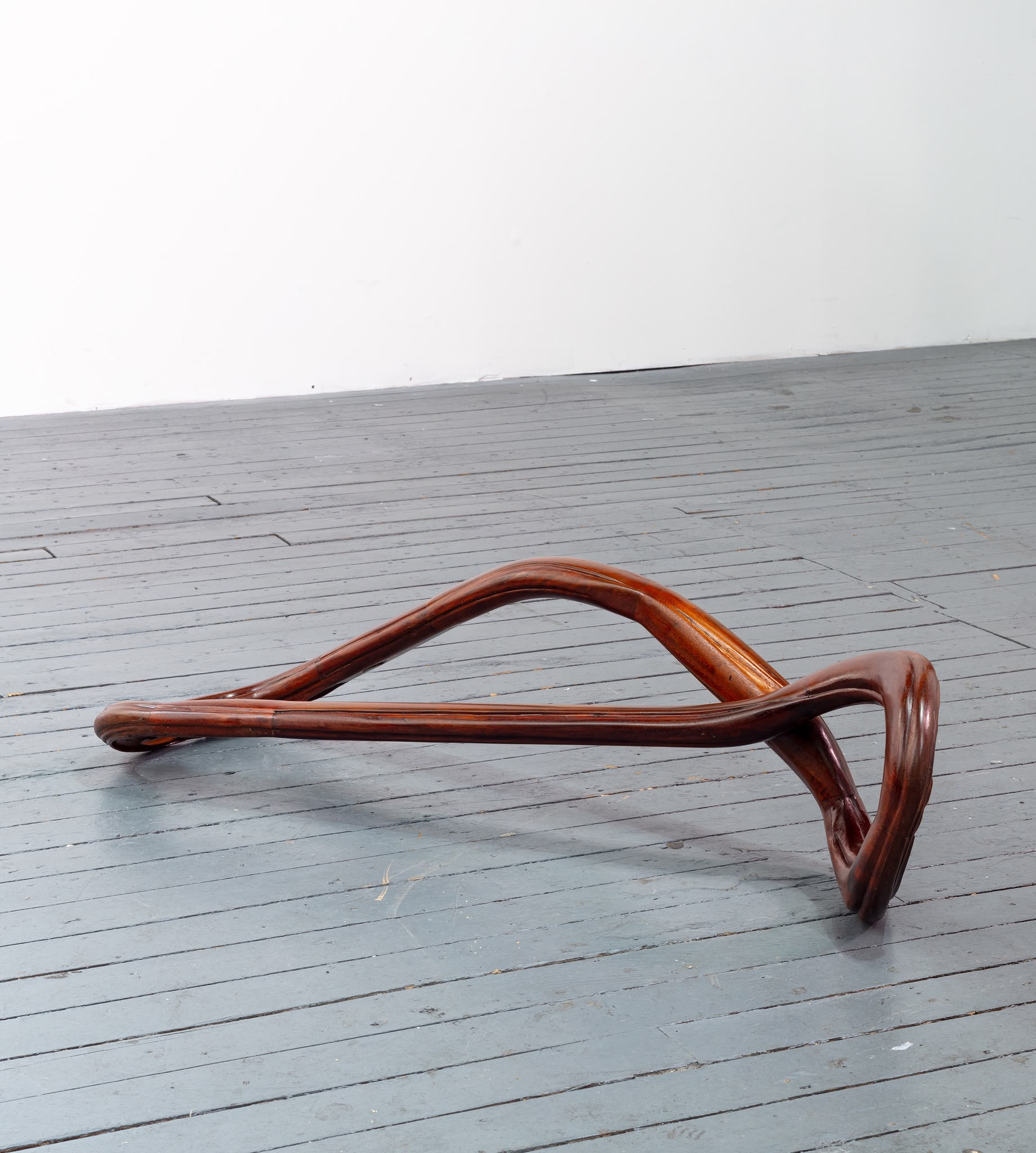
Neelova’s best-known works begin as staircases. She salvages wooden handrails from demolished houses and reassembles two or three flights of them, unaltered, so that the spiral closes into a loop, an infinity sign, or the ouroboros, the snake that swallows its own tail. A handrail, she points out, is made to fit the palm of a hand and then scaled up to architecture. Many were carved in the nineteenth century from mahogany and other hardwoods shipped from South America, Africa and the colonies. Then for a century or more they were touched by everyone who climbed the stairs. Each sculpture becomes a portrait of people, and often places, that are no longer there.
She often turns the rails inside out, revealing the underside where the balusters joined, and with it the little numbers and arrows the original craftsmen pencilled on to assemble them: “a way of communicating across time with people I’ve never met”. Builders are less charmed. Some are upset to see functional staircases taken apart, and she has become known around London as “the craziest staircase lady”, sawing rails to size in the street so they fit in her car. These days a lot of her material comes through Retrouvius, the architectural salvage firm, whose founder once found her three staircases across the country in a week.
Everything is undoing into something else
Looking at her work, Alexander always feels a sense of mortality: the materials will long outlive us. Neelova agrees, but finds it freeing. We are “temporary vessels” for much larger flows, of genes, of history, of capital, and a sculpture is just a temporary hardening of one of them. She doesn’t believe in stopping time, so her works are never quite finished. She remakes her own pieces and treats each exhibition as a chapter in a longer story.
It’s about cutting into the fabric of the world, pulling out some strands and weaving them into a new pattern.
Nika Neelova
That is why, despite her love of archaeology and history, her work is almost the opposite of conservation. She is not trying to preserve anything. She takes what already exists and transforms it, often by removing its function altogether. Making something useful useless, she says, is “my perverse idea of play”, a remark that, as Alexander observes, most parents will recognise.
Glass, breath and the evil eye
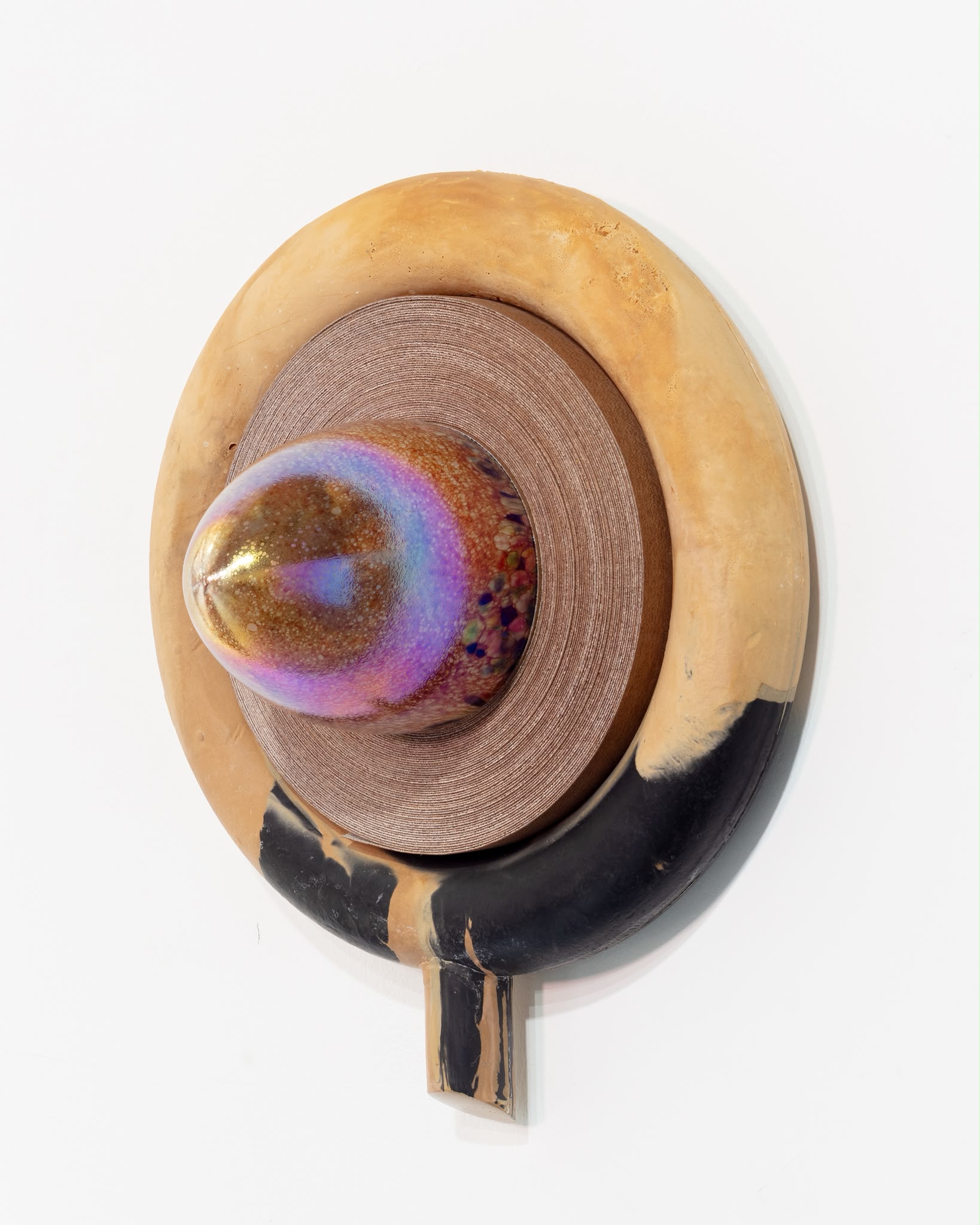
New this summer is a series of wall works built around hand-blown lampshades from Heron Glass, a now-closed glassworks in Cumbria. Neelova bought them from all over the country, “ghostly remnants” of a vanished workshop. She surrounds each one with veneer and cast anchor-chain links, so it becomes a version of the evil eye, or the gorgoneion: the Gorgon’s head that ancient people used to ward off harm. She mixes her own pigments to match each iris. Alexander felt they were watching him.
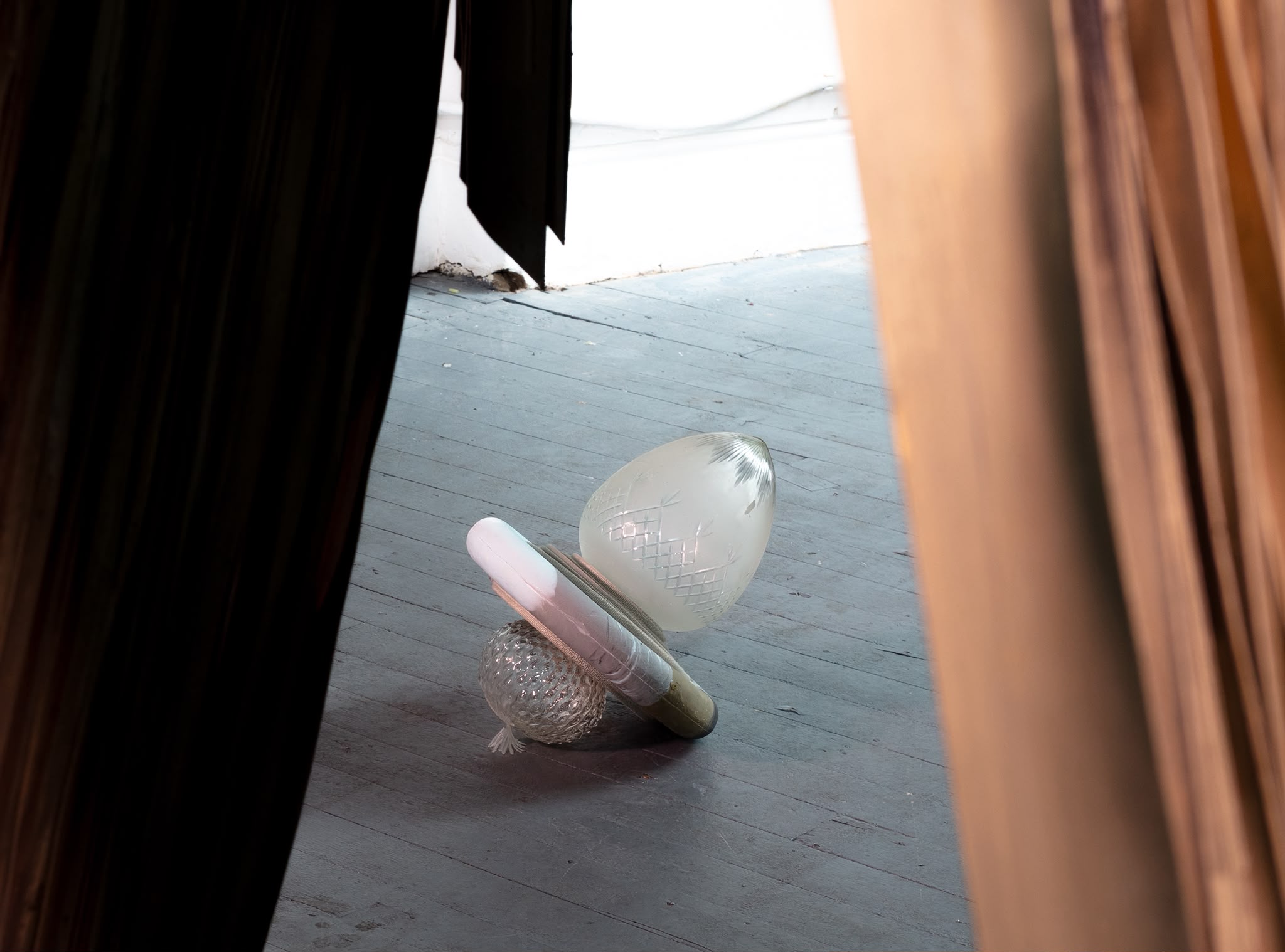
Glass fascinates her because it never fully sets. Even cooled, it is an amorphous solid whose molecules keep moving, and she tries to give that restlessness to everything she makes. Historically, too, glass was shaped by breath: the size of a vessel depended on the lungs of the person blowing it, so glass is the memory of the breath that made it. She is now making tear catchers from a Roman-style glass recipe without lime, which slowly dissolves. Glass that looks and behaves like glass, and then disappears. “I am a nightmare for conservationists,” she laughs.
Art as a contact sport
For all the philosophy, the work is relentlessly physical. Everything is made by hand in a fairly small studio, and the scale of each piece is set by what she can lift, carry and manoeuvre out of the door. She never needs a gym. Pressing her fingertips over and over into wet clay for a large work at Brighton CCA, she cracked a bone in her finger.
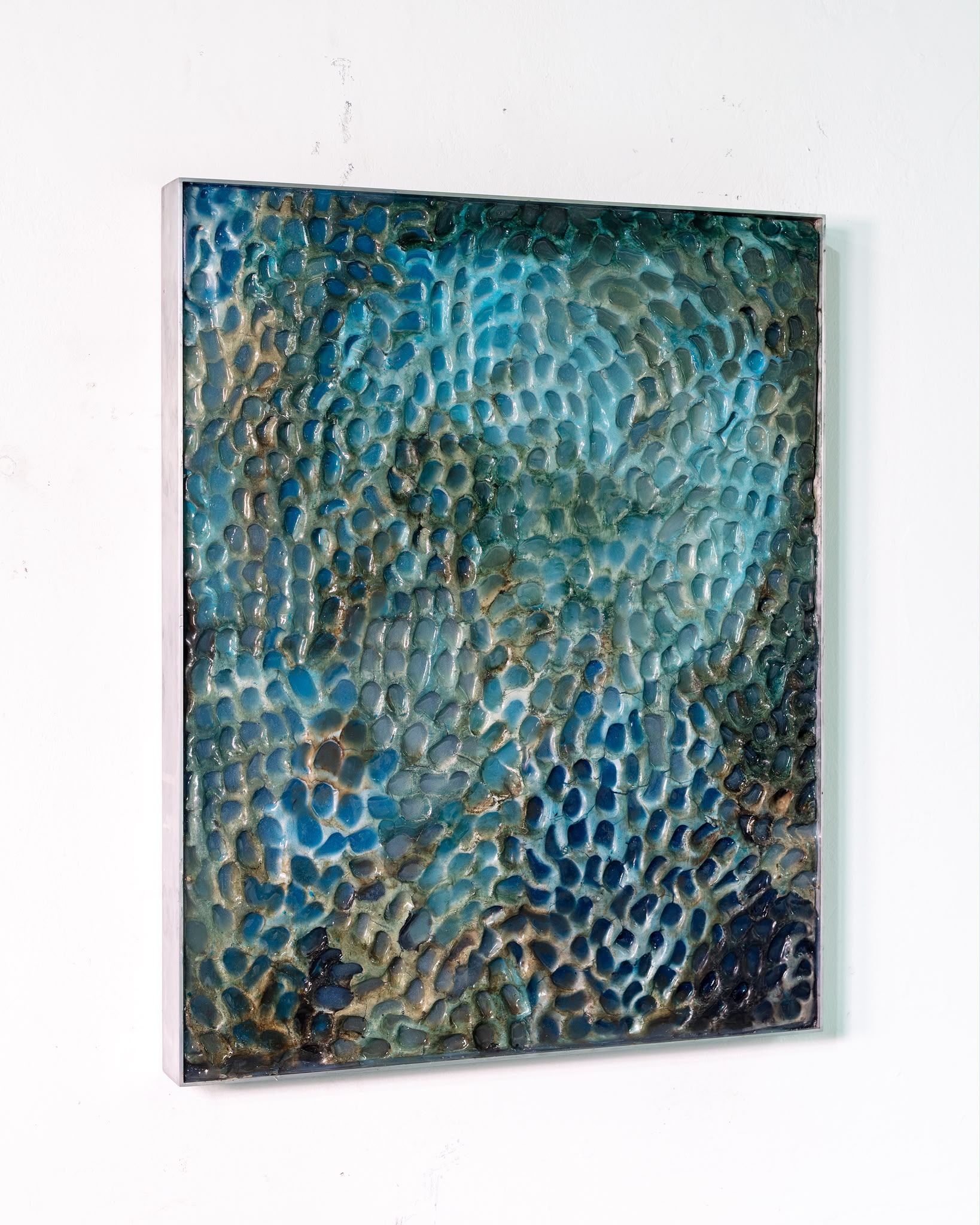
Those fingerprints appear in a smaller framed work in Gyre. It was inspired by a ripple stone in the Natural History Museum, a prehistoric wave pattern turned to stone, and by the networks of thermokarst lakes visible from the air over Siberia, which are drying out as the climate changes. The clay impressions are filled with oil and silicone, shading from clear blue into colours of pollution: “the pockmarks of humans on the planet, visualised by my finger marks”.
Handmade work carries its faults, the bubbles and uneven surfaces, and Neelova sees them as part of the process. As AI and 3D printing make flawless surfaces easy, she worries about a world of “surfaces that have nothing behind them”. Her own presence in the work is subtler than it looks. She tries to remove herself and collect anonymous traces instead: hands on a rail, breath in glass. Yet her restless switching between casting, woodwork, veneer and glass may, she thinks, come from a childhood of moving country every few years, from Russia to Paris to the Netherlands to the UK, “never fully belonging anywhere”.
Why “Gyre”?
A gyre is a vast circular system of ocean currents, one of the vortices that connect all the world’s seas. It suits the way she thinks: in loops and recurrences rather than straight lines, returning to old points of departure. Each work is an anchor point, and you can join them in different ways to read different stories. Where has the vortex taken her? “You never arrive anywhere,” she says. “That’s the beauty of the vortex.”
It is fitting that her favourite place in the world is the Warburg Institute library in London, where books are shelved by “the law of the good neighbour”, on the principle that the book you need is not the one you were looking for but the one beside it. Neelova’s sculptures work the same way.
Gyre was at The Bomb Factory, Holborn, until 20 September 2026.
Hear the full conversation in Episode 2 of Artworld Radio: Spotify, Apple Podcasts or YouTube, or browse all Artworld Radio episodes.
Installation photographs of Gyre, The Bomb Factory, 2026. [CHECK photo credit with Nika]